Table of Contents
How to Write a Resume with No Experience (2026 Guide)
No work history? No problem. This guide shows freshers exactly what to put on a resume, how to pass ATS filters, and how to build something recruiters actually read.
TL;DR
To write a resume with no experience, lead with a 2-3 line career summary, followed by education, a skills section built around the job description, and internships, projects, or volunteer work in place of formal experience. Add relevant certifications, keep it to one page. Tailor the summary and skills section for every application.
You have never had a job. Your resume is blank. And the application is due tomorrow.
This is the situation millions of freshers face every year, and most of them get it wrong. Either they pad the resume with fluff that fools no one, or they talk themselves out of applying altogether.
Here is what nobody tells you: every recruiter posting an entry-level role already knows you have no experience. They are not looking for a work history. They are looking for someone who is serious, structured, and has taken the time to present themselves properly.
That is entirely achievable regardless of whether you have ever been employed.
What you need is a resume that knows how to sell what you already have. And that is exactly what this guide is for.
Can I get a job with no experience on my resume?
Yes. Especially for entry-level, internship, and part-time roles, your resume is well-structured and tailored to the role.
Here's the context: job postings requiring specific years of experience dropped from 40% in October 2022 to 32.6% in October 2024, according to Indeed's 2025 Jobs and Hiring Trends Report. Employers are increasingly focused on what you can do, not just what you have done. A smart, skills-focused resume is your best tool in this environment.
Every professional you admire once had no experience. Employers hiring for entry-level roles know you are just starting out. What they are looking for is a clean, well-structured resume that shows you are serious, capable, and ready to learn. This guide walks you through exactly how to build that.
What recruiters look for when there is no work history:
Attitude and potential to grow
Relevant skills from school, side projects, or volunteering
A clean, easy-to-read resume that signals effort and professionalism
Signs that you understand the role you are applying for
What to Put on a Resume with No Experience
This is the most searched question for this topic, and the answer is simpler than most people expect. A no-experience resume is built around seven sections:
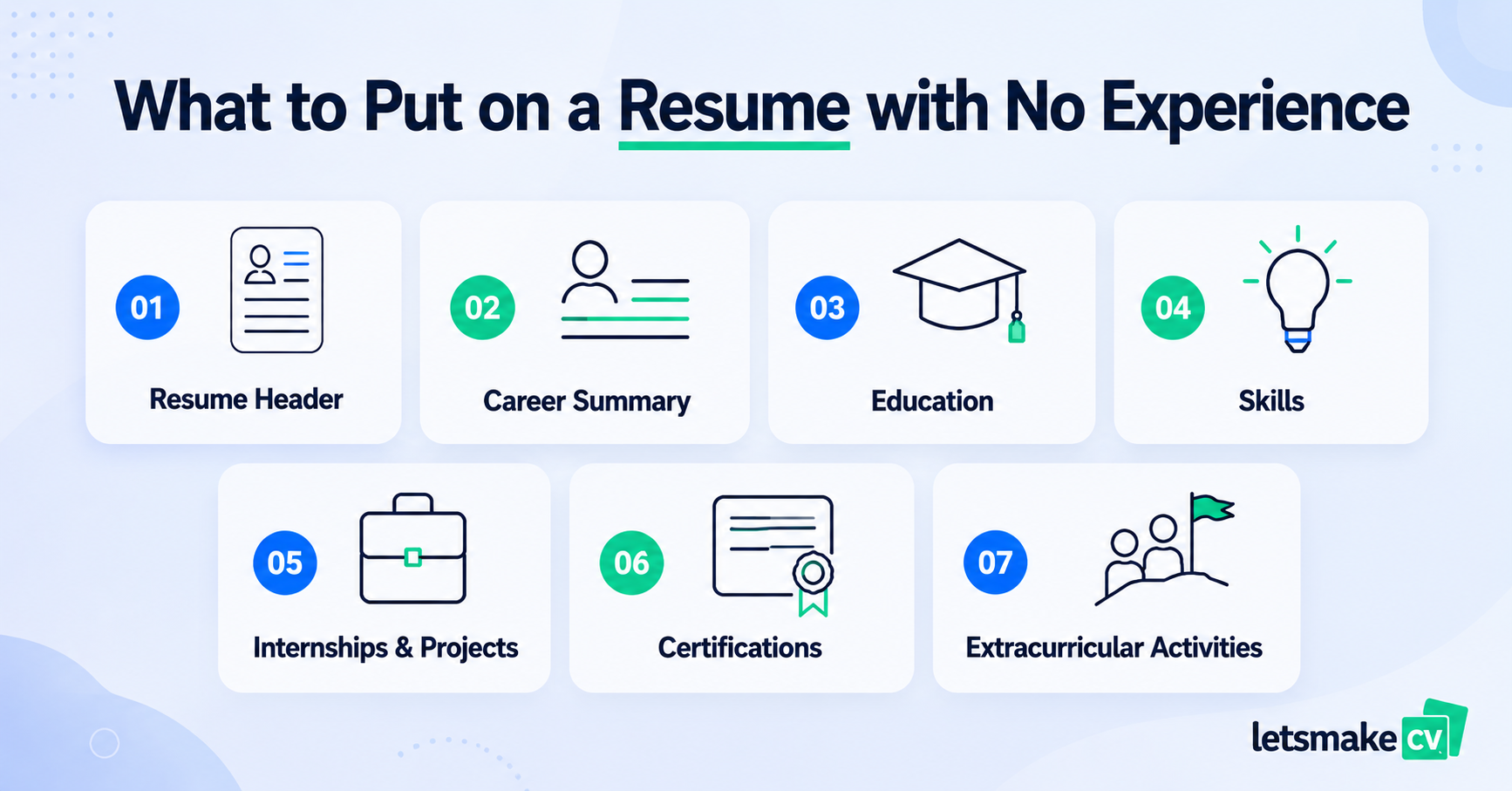
Resume header — name, phone, professional email, city, LinkedIn URL
Career summary — 2-3 lines about your skills and target role
Education — degree, institution, CGPA or percentage (if strong), relevant coursework
Skills — hard skills and tools matched to the job description
Internships or projects — paid, unpaid, academic, or personal
Certifications — Google, HubSpot, Coursera, AWS, and similar
Extracurricular activities — leadership roles, clubs, college events
A standard resume is experience-first. A no-experience resume is skills-first. It front-loads what you know and what you have done outside traditional employment.
If you want to know how to create the best CV, read our article: How to Write a Cover Letter That Gets You Hired (Expert Tips + Samples) |
Best Resume Format When You Have No Experience
The format you choose matters when you have limited work history. Here is how the three main formats compare:
Format | When to Use | Why It Works |
|---|---|---|
Functional | Zero formal work history | Group skills by category rather than timeline |
Combination | Some informal experience + skills | Shows both skills and a limited history |
Chronological | Even limited experience exists | Standard and most ATS-friendly |
Recommendation for zero-experience applicants: A combination or functional format that leads with a skills summary, followed by education, projects, and relevant activities.
How to Build Each Section of Your Resume (Step by Step)
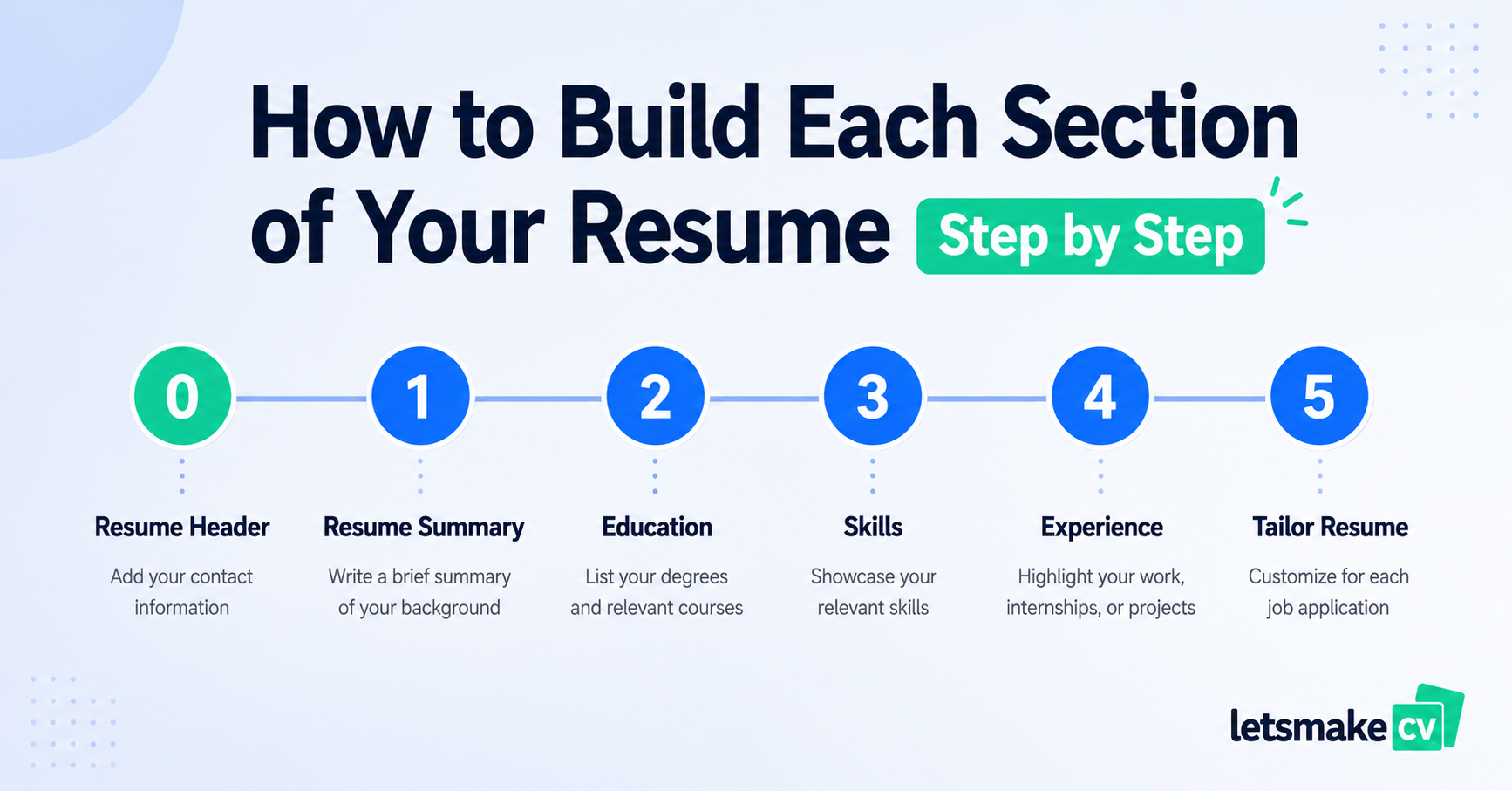
Step 0: Start with Your Resume Header
Your resume header is the first thing a recruiter sees. It needs to be clean, accurate, and complete.
What to include:
Full name — as you would want to be addressed professionally. No nicknames.
Phone number — one active number where you can actually be reached
Professional email — firstname.lastname@gmail.com is the standard. If your email is something like coolboy99@yahoo.com, create a new one before applying anywhere.
City only — not your full address. Just city and state: Bengaluru, Karnataka or Mumbai, Maharashtra
LinkedIn URL — only if your profile is complete. An empty LinkedIn profile does more harm than no link at all. Customise your URL to remove the default string of numbers.
Portfolio or GitHub — include this for tech, design, writing, or marketing roles if you have work worth showing
What does not go in the header: Date of birth, father's name, religion, marital status, or full home address. These are common on old Indian resume templates. Remove them.
Include | Leave Out |
|---|---|
Name, phone, professional email | Date of birth, father's name |
City and state only | Full home address with pin code |
LinkedIn (if profile is complete) | Religion, gender, marital status |
Portfolio or GitHub (if relevant) | Passport number, nationality |
Step 1: Write a Resume Summary That Actually Gets Read
A resume summary is different from a career objective. An objective is about what you want. A summary is about what you bring. For someone with no formal experience, a well-written summary is often the single most important part of the resume.
Formula: [Degree/field] graduate with [specific skill or project experience]. Skilled in [skill 1] and [skill 2]. Seeking a [target role type] position at [type of company or industry].
Examples: B.Com graduate with hands-on experience in digital marketing through a three-month internship at a D2C startup. Skilled in Meta Ads and Google Analytics. Seeking a performance marketing role at a growth-stage company.
Pro tip: Notice what these summaries do not say: "hardworking," "team player," "quick learner," "passionate." These phrases are on every resume and carry no weight. Show the recruiter something specific. |
Step 2: Put Your Education Where It Belongs
When you have no work history, education is your main credential. It goes near the top, right after the summary.
What to include:
Degree name and field of study
College or university name
Graduation year or expected graduation year
CGPA is 7.0/10 or above, or a percentage if 70% or above
Relevant coursework if it directly connects to the target job
Academic achievements, scholarships, or positions of responsibility
What to skip: If your scores are below those thresholds, leave them off. For most private-sector roles, strong projects and certifications outweigh a weak academic score.
Step 3: Build a Skills Section That Passes ATS
The skills section is where most no-experience resumes win or lose against ATS filters. Here is how to do it right:
Read the job description carefully. The exact words the employer uses are the keywords your resume needs to contain. If the posting says "Google Analytics," write "Google Analytics," not "web analytics tool." ATS systems do exact or near-exact matching.
Separate hard skills from soft skills. Tools, platforms, and software go in your skills section. Soft skills like "communication" are better demonstrated through your bullet points, not listed as keywords.
Only list skills you can back up. If you list Python, expect to be asked about it in the interview. A focused list of 8 to 12 relevant skills is stronger than a list of 25 that dilutes everything.
5 Formatting Mistakes That Get Your Resume Rejected Before Anyone Reads It
Most ATS systems extract text line by line. Anything that disrupts that extraction quietly kills your application.
Mistake 1: Building your resume in Canva. Canva exports image-based PDFs. The ATS sees a blank document. Build in Google Docs or Word instead, and export as a standard PDF. For ATS-compatible templates, use LetsMakeCV.
Mistake 2: Using a two-column layout. ATS software reads left to right across the full page width, merging content from both columns into one scrambled line. Use a single-column layout for all online applications.
Mistake 3: Putting contact details in the document header field. Most ATS parsers skip the Word document header entirely. Place your name and contact details in the main body of the document as regular text.
Mistake 4: Using tables, text boxes, or skill rating bars. ATS systems frequently skip content inside tables and text boxes entirely. Skill rating bars (filled circles or progress bars) communicate information visually that the ATS cannot read. Use plain text lists instead: Python | SQL | React | Git.
Mistake 5: Using decorative fonts, icons, or special bullet characters. Custom fonts and Unicode symbols often render as garbled text or [NULL]. Stick to Arial, Calibri, Georgia, or Times New Roman. Use standard round bullet points only.
Quick ATS checklist before you apply:
|
Step 4: Fill the Experience Section with What You Actually Have
No formal job history does not mean an empty experience section. Stack what you have in this order:
Internships (paid or unpaid both count, format them identically)
Academic or personal projects
Freelance or gig work
Volunteer work
Extracurricular roles and leadership positions
How to write bullet points that stand out:
Every entry needs at least one result, not just a task. A task tells the recruiter what you did. A result tells them what it means.
Weak: "Managed social media accounts for the college fest."
Strong: "Managed Instagram and LinkedIn for Techfest 2024, growing combined reach from 800 to 3,400 in six weeks."
Weak: "Worked on a machine learning project."
Strong: "Built a sentiment analysis model using Python and NLTK that classified 10,000 tweets with 84% accuracy."
If you cannot quantify a result, describe the scope: how many people were involved, how long it ran, and what the output was.
Action verbs for fresher bullet points:
Use these to start every bullet point. Group them by what you were actually doing:
Projects and technical work: Built, Developed, Designed, Deployed, Implemented, Programmed, Automated, Tested, Integrated
Leadership and organisation: Coordinated, Organised, Led, Managed, Spearheaded, Executed, Facilitated, Supervised
Communication and content: Wrote, Presented, Drafted, Edited, Published, Pitched, Produced, Translated
Research and analysis: Analysed, Researched, Evaluated, Identified, Assessed, Compiled, Reviewed, Reported
Collaboration and support: Assisted, Contributed, Collaborated, Represented, Volunteered, Trained, Supported
Need help writing strong bullet points? LetsMakeCV's AI builder suggests phrasing based on your role and industry. Start building for free! |
Step 5: Tailor Your Resume for Every Single Application
Sending the same resume to 50 companies is significantly less effective than sending a tailored resume to 10. Every job description uses different language, emphasises different skills, and is scanned by a different ATS configuration.
What to adjust for each application:
Resume summary: Swap in keywords and company type from the job description. Two minutes of editing moves you from generic to specific.
Skills section: Reorder to lead with what the JD emphasises most. If Excel is mentioned three times, it goes near the top.
Which projects or experiences appear first: Lead with the most relevant one for that role, not necessarily the most impressive overall.
7 Things You Should Not Include in Your Resume
Writing a strong resume is equally about what you leave out. These are the mistakes that quietly get Indian fresher resumes rejected before a recruiter reads past the first section.
Personal details that do not belong. Date of birth, father's name, religion, marital status, and gender do not belong on a job resume. Modern recruiters at startups, MNCs, and ATS-screened companies do not need this at the application stage, and it signals an outdated template.
A weak CGPA or percentage. If your CGPA is below 7.0/10 or your percentage is below 70%, leave it off. Recruiters at TCS, Infosys, and Wipro often have explicit score cutoffs. A weak number draws attention to a gap before you have had a chance to show anything stronger. If your score is strong, list it clearly: CGPA: 8.4/10.
The declaration at the bottom. "I hereby declare that all the above information is true and correct to the best of my knowledge." This line is on thousands of Indian fresher resumes. It adds zero value. Cut it.
A generic career objective. "To work in a challenging and dynamic environment where I can utilise my skills and grow as a professional." Recruiters read this dozens of times a day. Replace it with the 2-3 line career summary covered in Step 1 above.
Soft skills listed without evidence. "Good communication skills. Team player. Hardworking." None of this is verifiable from a bullet point. Show it instead: "Presented final-year project to a panel of 12 faculty members and industry judges." Every skill you claim needs evidence somewhere on the resume.
6. Irrelevant hobbies. Listening to music, watching cricket, travelling, and cooking tell a recruiter nothing. Hobbies belong on a resume only when they demonstrate a directly relevant skill. "Competitive chess player, state-level finalist" signals analytical thinking. "Runs a personal finance blog with 1,200 monthly readers" signals writing and financial knowledge. If your hobbies do not clear that bar, remove the section.
References available on request. Recruiters know they can ask. This line is wasted space on a one-page fresher resume. Delete it.
Start Building Your Resume for Free
Most first-time job seekers spend weeks overthinking their resume and never send it. The candidates who get interviews are usually not the most qualified; they are the ones who built something clean, tailored it to the role, and actually hit apply.
You have the sections. You have the format. You have the examples. The only thing left is building it.
Build your free ATS-ready resume on LetsMakeCV
No design experience, no paid subscription, no resume writing background needed. Pick a template, fill in your sections, and download in minutes. Your first application is closer than you think.
Frequently Asked Questions
1. What is the best resume format when you have no experience?
A functional or combination format works best. It leads with skills and relevant activities rather than a chronological work history, which benefits applicants who have not held formal jobs yet.
2. How long should a resume be with no experience?
One page. There is no reason to go to a second page when you have limited work history; doing so often hurts your chances rather than helping.
3. Should I include a photo on my resume with no experience?
It depends on the country. In India and parts of the Middle East, a small professional photo is common and generally expected. In the US, UK, and Canada, photos are not recommended and can introduce bias. Follow the norms for the country and industry you are applying in.
4. What if I have absolutely nothing to put on a resume?
You always have something. Think about coursework you excelled in, projects you worked on in school, any volunteering, clubs, sports, or community activities, online courses or certifications you have completed, and basic software or language skills. Spending a few weekends completing a free Google or HubSpot certification will give you something credible to add immediately.
5. What is the difference between a resume objective and a resume summary?
A resume objective states what you are looking for in a job. A resume summary states what you bring to a job. For freshers with no experience, a summary is the stronger choice because it focuses on your skills and potential rather than your wants. Objectives are still common in India for entry-level applications but a well-written summary consistently performs better with modern recruiters.
6. Can I use the same resume for every job application?
You can, but you should not. A generic resume typically scores lower in ATS matching because different job descriptions use different keywords. At minimum, adjust your career summary and reorder your skills section for each application to mirror the language in the job posting. This takes two to three minutes per application and meaningfully improves your callback rate.
Related Articles
More articles you might find interesting

Keywords to Use in a Resume: The 2026 Guide That Actually Works
Learn how ATS filters resumes and why keywords matter in 2026. This guide explains keyword types, sourcing them from job descriptions, smart placement across resume sections, ideal keyword density, and practical examples to optimize resumes, avoid rejection, and improve chances.
Monisha Sri

How to Write a Cover Letter That Gets You Hired (Expert Tips + Samples)
This article provides a practical, step-by-step guide to writing a modern, recruiter-friendly cover letter that improves shortlisting chances. It explains what a cover letter is, why it still matters, and how to structure each section using ATS-friendly formatting and real hiring best practices.
Monisha Sri

ATS Optimized Resume: How to Beat Applicant Tracking Systems (2026)
If your resume isn’t getting callbacks, ATS may be the reason. This blog breaks down how ATS works, common resume mistakes, and how to optimize your resume so it passes screening and reaches recruiters.
System Administrator
